

Albert Einstein When Albert Einstein was a young physics student in Zurich, he skipped many of his advanced math classes. He thought they were unnecessary—just theory without practical use. But one person did attend: Marcel Grossmann, Einstein’s classmate and lifelong friend. Grossmann took detailed notes, and when exam time came, he lent them to Einstein. That was enough to get by. Years later, as Einstein was developing what would become the general theory of relativity, he hit a wall. The physics he imagined was revolutionary—it curved time and space. But the math needed to describe it? He didn’t have it. So he turned to the same friend who had helped him years before. Grossmann, now a mathematics professor, introduced Einstein to tensor calculus and Riemannian geometry—tools Einstein would use to transform our understanding of the universe. He even co-authored an early paper with Einstein on the theory’s mathematical foundations. Einstein later admitted that skipping those classes was a mistake. But thanks to Grossmann, he got a second chance. And because of their collaboration, the world gained one of its most profound scientific breakthroughs. Behind every genius, there’s often someone quietly supporting them—with notes, patience, and brilliance of their own. Follow Us – Whimsy & Weird Facts

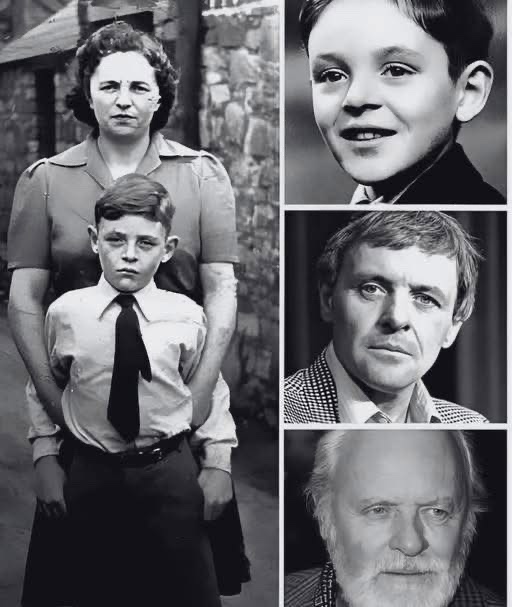
ဘဝတွေကို ရုနိးကန်ခဲ့ရသော ရုပ်ရှ ကမ္ပာကျော် င်မင်းသားကြီး ANTHONY HOPKIN. Absolutely beautiful it’s pure love ❤️
.Credits goes to respective owners. https://fb.watch/BM6NQDsy7N/? Eight-year-old Anthony Hopkins sat alone at his desk in 1946, the muffled laughter of classmates swirling around him. At Cowbridge Grammar School in South Wales, he always felt like an outsider, a boy who couldn’t quite fit in. His classmates loved games and jokes, but Anthony’s mind wandered elsewhere. Teachers, mistaking his struggles with dyslexia for slowness, labeled him “slow,” a judgment that only deepened his sense of isolation. One memory stands out. During recess, while the other children played, Anthony sat on a cold bench with a sketchpad, creating imaginary worlds. A teacher glanced at his drawing—a castle on a jagged cliff—and told him, “You have a gift.” For Anthony, those few words of recognition stayed with him. Not long after, he found another refuge: the piano. By the age of nine, he was sneaking into the music room to experiment with the keys, teaching himself melodies. Music gave him a language when words failed. His parents, noticing his passion, saved enough to buy him a secondhand piano. After school, Anthony would lose himself in music, filling the house with notes that gave him comfort. Still, the loneliness lingered. “I felt like an alien,” he would later say. His dyslexia left him frustrated and misunderstood. Friendships never came easily, so he retreated further into art and music. By twelve, his sketches were detailed and his piano skills more advanced, but he remained on the sidelines, watching others bond in ways he couldn’t. Instead of giving in to despair, he channeled everything into his creativity. Through those long solitary hours, Anthony sharpened his ability to observe and absorb, skills that would later shape his acting. His mother, Muriel, played a vital role during this time. She reassured him, “You don’t have to be like everyone else. Being different is not a weakness—it’s a strength.” Her encouragement gave him the courage to embrace what made him unique. As he moved into his teenage years, those outlets—drawing and music—became anchors. What once felt like loneliness slowly turned into perspective. He realized his outsider status allowed him to see life in ways others could not. That depth of observation, born from solitude, became the foundation of his craft as an actor. Anthony Hopkins’ early struggles with loneliness and alienation were not just obstacles—they became the crucible of his creativity and empathy. From those quiet benches and late-night piano sessions came the emotional depth and complexity that would later make him one of the greatest actors of his generation. His journey from the lonely boy with a sketchpad to the celebrated actor we know today is a powerful reminder that our deepest struggles can shape our greatest strengths. Credit goes to respective owner. Follow Us – Whimsy & Weird Facts
He hadn’t meant to fall asleep. But her breath was slow and steady, her trunk curled gently across his chest like a question already answered. And in that moment of stillness, he let go—for just a little while. He had been up before sunrise—feeding the orphans, soothing their cries. Young elephants, taken too soon from their mothers, still waking in fear. He didn’t force comfort. He simply stayed close. Quiet. Steady. Patient. She was the first to trust him. Not because he asked for it. Because he waited for it. One morning, she walked to where he sat and slowly lay beside him. Then, gently, she wrapped her trunk around him—like a soft promise. He rested his hand on hers. Not to control, not to lead—just to say: You’re safe. I’m here. They stayed like that. Man and elephant. Breathing together. Healing together. If that sounds impossible, maybe it’s because we’ve forgotten what real connection looks like. But this—this is what it looks like when fear fades. When trust wins. When love doesn’t need words. If you find this story meaningful, please take a moment to read more of my heartfelt sharing. Sometimes, we need to look back at ourselves and what is happening around us.

“I asked a friend who has crossed 70 & is heading towards 80 what sort of changes he is feeling in himself? He sent me the following:
- After loving my parents, my siblings, my spouse, my children and my friends, I have now started loving myself.
- I have realized that I am not “Atlas”. The world does not rest on my shoulders.
- I have stopped bargaining with vegetable & fruit vendors. A few pennies more is not going to break me, but it might help the poor fellow save for his daughter’s school fees.
- I leave my waitress a big tip. The extra money might bring a smile to her face. She is toiling much harder for a living than I am.
- I stopped telling the elderly that they’ve already told that story many times. The story makes them walk down memory lane & relive their past.
- I have learned not to correct people even when I know they are wrong. The onus of making everyone perfect is not on me. Peace is more precious than perfection.
- I give compliments freely & generously. Compliments are a mood enhancer not only for the recipient, but also for me. And a small tip for the recipient of a compliment, never, NEVER turn it down, just say “Thank You.”
- I have learned not to bother about a crease or a spot on my shirt. Personality speaks louder than appearances.
- I walk away from people who don’t value me. They might not know my worth, but I do.
- I remain cool when someone plays dirty to outrun me in the rat race. I am not a rat & neither am I in any race.
- I am learning not to be embarrassed by my emotions. It’s my emotions that make me human.
- I have learned that it’s better to drop the ego than to break a relationship. My ego will keep me aloof, whereas with relationships, I will never be alone.
- I have learned to live each day as if it’s the last. After all, it might be the last.
- I am doing what makes me happy. I am responsible for my happiness, and I owe it to myself. Happiness is a choice. You can be happy at any time, just choose to be!
Why do we have to wait to be 60 or 70 or 80, why can’t we practice this at any stage and age?”

Incredible Stuff – My favorite video .The life of a teddy bear mother is not easy https://m.facebook.com/groups/526234578603677/permalink/666668034560330/?
She called for him to,and he came .How sweet they take care of each other .Animals have affection than humans. https://fb.watch/BM86hwcS8c/?
I bet this is the most adorable thing you’ll see today https://m.facebook.com/groups/526234578603677/permalink/1125383085355487/?

The bridge-tunnel in Virginia, USA is an amazing engineering feat that spans 17 miles, connecting the Atlantic Ocean to multiple ports along rivers and bays. It seamlessly transforms from a bridge to an undersea tunnel, accommodating both vehicles and large ships. This incredible structure is essential for maritime trade and provides a captivating experience for travelers. As you drive across the bridge, you’ll enjoy breathtaking views of the surrounding landscape. But the real adventure begins when you enter the undersea tunnel. Descending below the water’s surface, you’ll be immersed in a mesmerizing subaquatic world. The tunnel’s design and lighting add to the enchantment as you journey through its vast length. It’s a must-visit attraction for anyone traveling along the East Coast, combining the excitement of driving on a bridge with the wonder of exploring an undersea tunnel.

LARGEST TREE IN THE WORLD
Location: Giant Forest, Sequoia National Park, Tulare County, California, USA
The General Sherman Tree holds the title of the world’s largest tree by volume. Standing at an impressive 275 feet (83 m) tall, its base spans over 36 feet (11 m) in diameter. Even as you look higher up, the Sequoia trunk remains remarkably wide. At 60 feet above the base, its diameter is still 17.5 feet (5.3 m).
Estimated to be between 2,300 and 2,700 years old, this ancient giant continues to stand as a living testament to nature’s immense power.

In a recent candid interview, Tom Hanks revealed that Forrest Gump (1994) came dangerously close to never being completed. The issue wasn’t with the script or casting; it was money. Paramount Pictures had pulled back significant financial support midway through production. Facing massive budgetary gaps, Hanks and director Robert Zemeckis made an unorthodox and risky decision: they would pay for the film themselves.
Hanks explained that two major sequences were on the chopping block due to budget constraints. One was the now-iconic cross-country running montage. The studio did not see the value in funding what it considered a drawn-out and unnecessary portion of the film. Hanks disagreed. He believed those scenes were vital to Forrest’s emotional journey and said to Zemeckis, “We’ll do it, but we’ll do it on our own dime.” The two negotiated a deal where they would fund certain portions of the production personally in exchange for a share of the profits. It was a gamble that could have backfired dramatically.
The financial risk they took was not light. Hanks reportedly invested a significant portion of his salary back into the film. At the time, there was no guarantee the movie would even connect with audiences. The story of a slow-witted but kind-hearted man traveling through pivotal moments in American history sounded “too strange to market,” as one studio executive allegedly put it. Test screenings were uncertain, and there were fears it would not find an audience.
When Forrest Gump premiered in 1994, no one predicted it would dominate the box office. It went on to gross over $678 million worldwide and won six Academy Awards, including Best Picture, Best Director, and Best Actor for Hanks. Reflecting on that wave of unexpected success, Hanks admitted he was stunned. “I thought people might like it, maybe connect with Forrest’s innocence. But the reaction? That was something else entirely.”
He described attending early screenings and being overwhelmed by the audience’s emotional response. “People weren’t just laughing or clapping. They were crying. Complete strangers were hugging after the credits. I’d never seen anything like that in my career.” Hanks confessed that seeing viewers bond with a character who believed in simple virtues like love, loyalty, and honesty moved him deeply. He said that one moment cemented it for him: “A man came up to me in tears and said, ‘Forrest reminded me of my brother. He passed away last year.’ That’s when I knew this movie had hit somewhere beyond just entertainment.”
The scale of success stunned even the most seasoned Hollywood insiders. For a film no one originally believed in, one that nearly lost key scenes due to budget cuts, the reaction felt surreal. Hanks described Oscar night as dreamlike. “I was backstage with Robert, and we looked at each other like, ‘How did this even happen?’ A year before, we were trying to keep it alive with our own checkbooks. Now, we’re standing here with golden statues.”
Looking back, Hanks sees the experience as a lesson in faith. Not in studios or profits, but in story. “I didn’t know if it would make money. I just knew it was worth telling. Sometimes that’s the only reason you need.”
Two artists refused to let their vision be compromised by doubt or budget lines. Forrest Gump proved that sometimes the heart behind a film is its greatest asset.

When Mark Twain married Olivia Langdon, he told a friend:
“If I’d known how happy married life would make me, I’d have married 30 years earlier—skipping the whole business of growing teeth.”
He was 32 at the time.
They couldn’t have been more different. Samuel Clemens (Twain’s real name) grew up in a poor family, worked from a young age, and tried his hand at everything — from piloting steamboats to mining silver — before becoming a writer. Olivia was the refined daughter of a wealthy businessman.
Twain fell in love with her… before they even met. A friend showed him a locket with Olivia’s portrait and invited him to visit. Within two weeks of meeting her in person, he proposed. She declined. Twice. The first time, she cited the age gap and his rough manners. The second time, his lack of religious devotion. Twain promised to become a good Christian for her, but still, she hesitated — even though in her heart, she already loved him.
Fate intervened when his carriage overturned on the way out of town. Pretending to be seriously injured, Twain ended up back in her home. Olivia offered to nurse him — and after yet another proposal, she finally said “yes.”
From that day on, Twain did everything to keep her happy. He read her the Bible every evening, prayed before meals, and even kept 15,000 pages of his writing unpublished because he knew she wouldn’t approve. She was his first editor, censoring anything too bold — once even removing Huck Finn’s “Confound it!” because it was too coarse.
Twain once said: “I’d stop wearing socks if she told me it was immoral.” She called him her “gray-haired boy” and looked after him as if he were one. In return, he credited her with keeping his energy, humor, and childlike spirit alive.
Even in hard times — losing children, bankruptcy, Olivia’s illness — they leaned on each other. Twain’s humor was her medicine; he filled their home and garden with silly notes to make her smile, even instructing birds when and how loudly to sing outside her window.
They never raised their voices to each other, never had a scandal, and never stopped being each other’s safe place. For one of her birthdays, Twain wrote:
“Every day we’ve lived together has deepened my certainty that we will never regret uniting our lives. With every year, my love for you, my dear, grows stronger. Let’s look forward — to future anniversaries, to old age — without fear or sadness.”
A love story for the ages.

The Granby-Dewey Oak is estimated to be nearly 500 years old! The tree was 300 years old when our brash young nation celebrated its Centennial. Then came the automobile, World War I, electricity, telephones, radio, World War – But the Oak remained constant. 1976 — America is 200 years old! The Granby Oak is twice that. Its branches are heavy with age and touch the ground. It is alive and healthy. Located in Granby, CT.
Photo by Jerry Horowitz

A gorgeous cherrybark oak (quercus pagoda) located in Virginia Beach. Measuring over 26’ in circumference with a huge 140’ crown (branch) spread, this is one of the largest and most beautiful oaks in the state!
On private property. Photo credit Big Trees of Virginia – Dylan Kania
 မှတ်ဖွယ်မှတ်ရာ စာပဒေသာ