
https://www.facebook.com/reel/4082894462031858?fs=e&fs=e&s=TIeQ9V
https://www.facebook.com/reel/685342614032883?fs=e&fs=e&s=TIeQ9V
https://www.facebook.com/reel/685342614032883?fs=e&fs=e&s=TIeQ9V
https://www.facebook.com/reel/1759165448279251?fs=e&fs=e&s=TIeQ9V
https://www.facebook.com/reel/1056133596326183?fs=e&fs=e&s=TIeQ9V
BBC News on Myanmar Earthquake ( 4 April 2025 ) hours ago
BBC Verify: What satellite images reveal about Myanmar’s quake

The military government in Myanmar has said at least 2,000 people were killed in the 7.7 magnitude earthquake that hit last Friday. A death toll over 10,000 is a strong possibility,” according to the US Geological Survey. The Burmese army, which has previously downplayed civilian casualties after other large natural disasters, is not allowing foreign journalists into the country. From neighbouring Thailand, BBC Verify’s Nick Beake has been building a picture of the impact of the quake in the worst affected areas that we know about. Produced by Thanyarat Doksone. Graphics by Mesut Ersoz. Verification by Benedict Garman, Paul Brown, Kumar Malhotra, Emma Pengelly, Jake Horton
https://bbc.com/news/videos/cn4wzyv21jvo
What do you want BBC Verify to investigate?
What caused the Myanmar earthquake – and why did it make a tower in Bangkok collapse?
4 days ago
Esme Stallard
Climate and science reporter, BBC News
Vicky Wong
BBC News
Share
Save

0:23
Moment Bangkok high-rise collapses following Myanmar earthquake
A major earthquake in Myanmar on Friday has caused more than 3,000 deaths and led to the collapse of numerous structures.
Even though the south-east Asian nation is a high risk region for earthquakes, neighbouring Thailand and China – which were also affected by the quake – are not.
The Thai capital, Bangkok, sits more than 1,000km (621 miles) from the epicentre of Friday’s earthquake – and yet an unfinished high-rise building in the city was felled by it.
Here we will explain what caused this earthquake, and how it was able to have such a powerful effect so far away.
ADVERTISEMENT
• Follow updates on this story
What caused the earthquake?
The earth’s upper layer is split into different sections, called tectonic plates, which are all moving constantly. Some move alongside each other, whilst others are above and below each other.
It is this movement that causes earthquakes and volcanoes.
Myanmar is considered to be one of the most geologically “active” areas in the world because it sits on top of the convergence of four of these tectonic plates – the Eurasian plate, the Indian plate, the Sunda plate and the Burma microplate.
The Himalayas were formed by the Indian plate colliding with the Eurasian plate, and the 2004 Tsunami as a result of the Indian plate moving beneath the Burma microplate.
Dr Rebecca Bell, a reader in tectonics at Imperial College London, said that to accommodate all of this motion, faults – cracks in the rock – form which allow tectonic plates to “slither” sideways.
There is a major fault called the Sagaing fault, which cuts right through Myanmar north to south and is more than 1,200km (746 miles) long.
Early data suggests that the movement that caused Friday’s 7.7-magnitude earthquake was a “strike-slip” – where two blocks move horizontally along each other.
This aligns with the movement typical of the Sagaing fault.
As the plates move past each other, they can become stuck, building friction until it is suddenly released and the earth shifts, causing an earthquake.

Why was the earthquake felt so far away?
Earthquakes can happen at up to 700km (435 miles) below the surface. This one was just 10km from the surface, making it very shallow. This increases the amount of shaking at the surface.
The earthquake was also very large – measuring 7.7 on the moment scale. It produced more energy than the atomic bomb dropped on Hiroshima, according to the US Geological Survey.
The size of the quake was because of the type of fault, said Dr Bell.
“The straight nature [of the fault] means earthquakes can rupture over large areas – and the larger the area of the fault that slips, the larger the earthquake,” she explained.
“There have been six magnitude 7 or greater earthquakes in this region in the last century.”
This straight fault also means a lot of the energy can be carried down its length – which extends for 1,200km south towards Thailand.
When it comes to why the earth shook so much, scientists believe it is because the quake was a rare “super shear” – meaning energy from the rupture in the earth’s crust built up because it was moving faster than seismic waves can travel through the earth.
Seismologist Prof Frederik Tilmann, from the Helmholtz Centre for Geosciences in Germany, explained in analysis shared online that the rupture travelled at a speed of about 5km per second – making it “the earthquake equivalent of a supersonic jet”.
Because the fracture “unzipped” towards the south, it also directed this piled up energy towards the Thai capital, Bangkok, and this is why the earthquake had such an impact so far away.
How earthquakes are felt at the surface is also determined by the type of soil.
In soft soil – which is what Bangkok is built on – seismic waves (the vibrations of the earth) slow down and build up, getting bigger in size.
So, Bangkok’s geology would have made the ground shaking more intense.
ADVERTISEMENT
Why did just one skyscraper collapse in Bangkok?
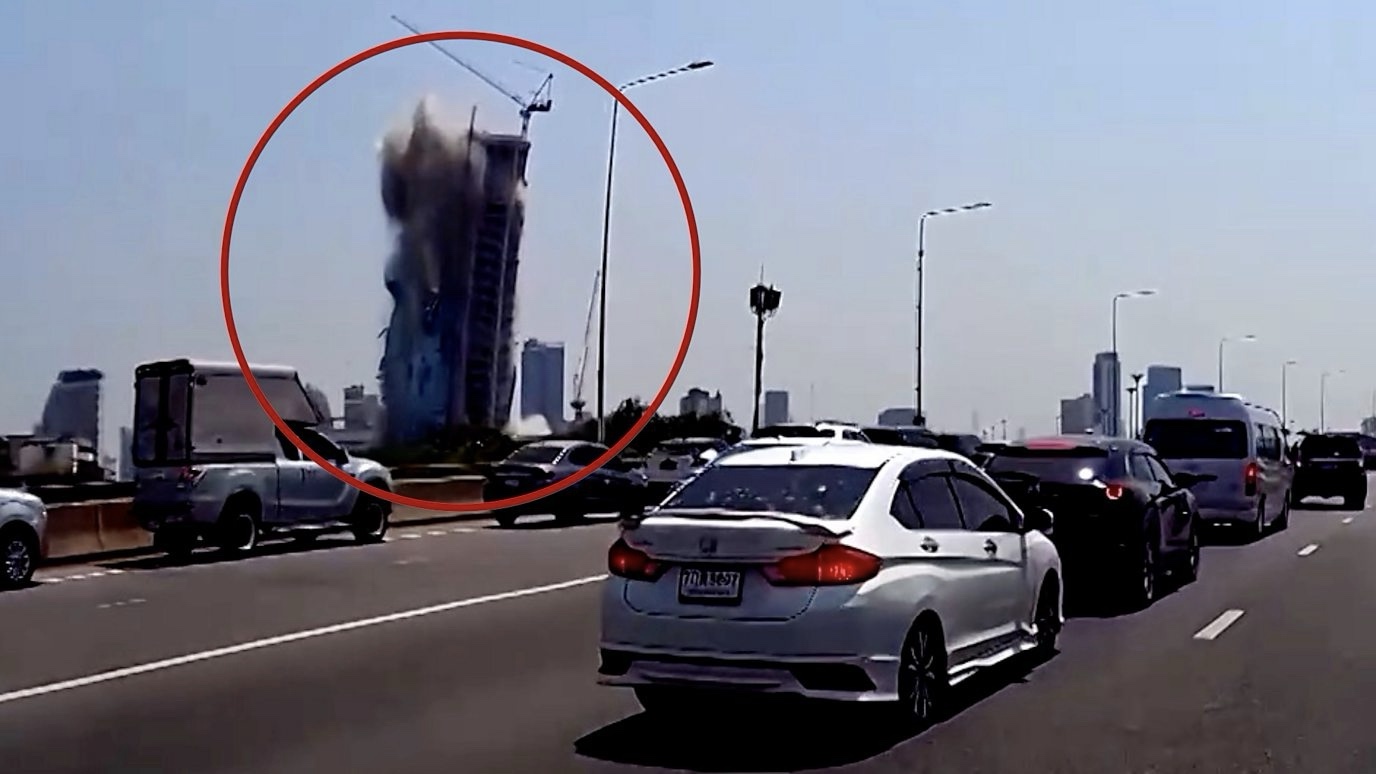
While dramatic footage has emerged of high-rise buildings in Bangkok swaying during the quake – knocking water from rooftop pools – the unfinished headquarters for the auditor-general’s office Bangkok’s Chatuchak district appears to be the only skyscraper to collapse.
Prior to 2009, Bangkok did not have a comprehensive safety standard for constructing buildings to withstand earthquakes, according to Dr Christian Málaga-Chuquitaype, a senior lecturer in earthquake engineering at Imperial College London.
This means that older buildings would have been particularly vulnerable.
This is not unusual, as earthquake-resistant buildings can be more expensive to construct and Thailand, unlike Myanmar, does not frequently experience earthquakes.
Dr Emily So, a professor of architectural engineering at the University of Cambridge, noted that older buildings can and have been strengthened, such as in California, western Canada and New Zealand.
ADVERTISEMENT
0:22
Watch: Dashcam captures moment Bangkok building collapses
Prof Amorn Pimarnmas, president of the Structural Engineers Association of Thailand, said that while there were regulations in 43 provinces on earthquake-proofing buildings, less than 10% of buildings are estimated to be quake-resistant.
Yet the building that collapsed was new – in fact, it was still under construction when the earthquake hit – and the updated building standards would have applied.
Dr Pimarnmas said Bangkok’s soft soil may have also played a part in its collapse, as it can amplify ground motions three or four times over.
He added: “However, there are other assumptions such as material (concrete and reinforcements) quality and some irregularity in [the] structural system. These remain to be investigated in detail.”
Having studied the video, Dr Málaga-Chuquitaype said it appears a “flat slab” construction process was being favoured – which is no longer recommended in earthquake-prone areas.
“A ‘flat slab’ system is a way of constructing buildings where floors are made to rest directly on columns, without using beams,” he explained.
“Imagine a table supported only by legs, with no extra horizontal supports underneath.
“While this design has cost and architectural advantages, is performs poorly during earthquakes, often failing in a brittle and sudden (almost explosive) manner.”
At least 15 still alive under Bangkok skyscraper rubble, rescuers say
Myanmar earthquake: What we know
BBC reporter on desperate search for survivors in rubble of 30-storey building
What about the buildings in Myanmar?
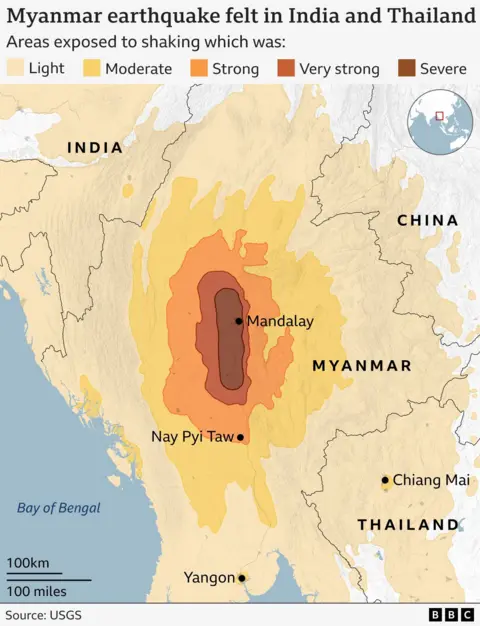
Mandalay in Myanmar was much closer to where the ground slipped and would have experienced significantly more severe shaking than Bangkok.
Although Myanmar regularly experiences earthquakes, Dr Ian Watkinson, a lecturer in earth sciences at Royal Holloway University, thought it was unlikely that many buildings were constructed to be earthquake-proof.
“General poverty, major political upheaval, alongside other disasters – e.g. the Indian Ocean tsunami in 2004 – has distracted the country from concentrating on the unpredictable risks from earthquakes,” he said.
“This means that, in many cases, building design codes are not enforced, and construction happens in areas that could be prone to enhanced seismic risk, for example flood plains and steep slopes.”
Parts of Mandalay and its buildings also lie along the floodplain of the Ayerwaddy River. This makes them very vulnerable to a process called liquefaction.
This happens when the soil has a high water content, and the shaking causes the sediment to lose its strength and behave like a liquid. This increases the risk of landslides and building collapses, as the ground can no longer hold them up.
Dr So warned that there was “always a chance” of further damage to buildings near a fault line due to aftershocks – tremors that follow an earthquake, which can be caused by the sudden transfer of energy into nearby rock.
“Most of the time aftershocks are smaller than the main shock, and tend to decrease in size and frequency over time,” she said.
Why earthquake predictions are usually wrong
What happened at Fukushima 12 years ago?
RELATED
UK charities launch Myanmar Earthquake Appeal
How aid becomes a weapon in Myanmar’s war zone
MORE
The complex operation to fix ‘UK’s wonkiest road’
Experts explain the complex operation to repair the road after a storm left it with huge cracks.
17 hrs ago
Wiltshire
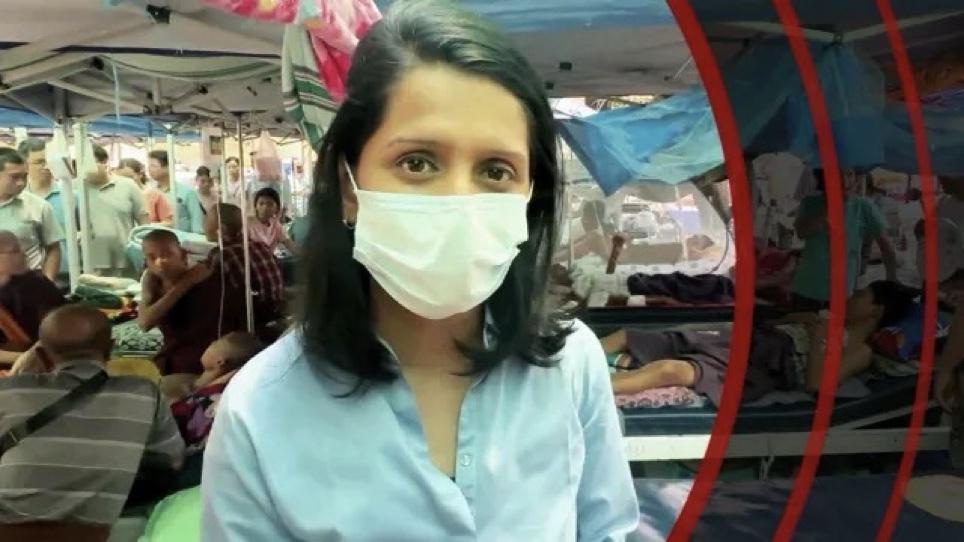
Inside Mandalay: BBC joins rescuers searching for earthquake dead in Myanmar
The BBC’s Yogita Limaye is the first foreign journalist to enter the country since the disaster struck.
Myanmar quake: Imam’s grief for 170 killed as they prayed in Sagaing
BBC NEWS
Myanmar quake: Imam’s grief for 170 killed as they prayed in Sagaing
2 days agoShareSave
Zeyar Htun and Tessa Wong
BBC Burmese and BBC News
Reporting fromBangkok
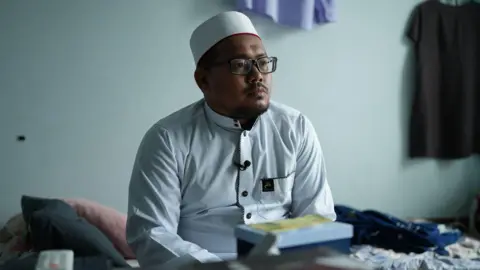
As the call to prayer rang out in Sagaing last Friday, hundreds of Muslims hurried to the five mosques in the city in central Myanmar.
They were eager to hold their last Friday prayers for Ramadan, just days away from the festive period of Eid that would mark the end of the holy month.
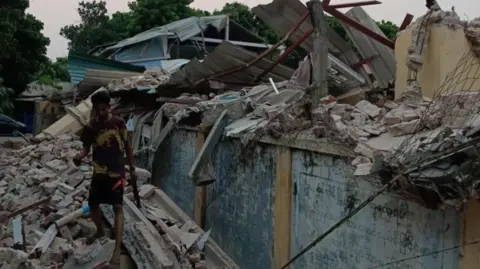
Then, at 12:51 local time (06:21 GMT), a deadly earthquake struck. Three mosques collapsed, including the biggest one, Myoma, killing almost everyone inside.
Hundreds of kilometres away, the former imam of Myoma mosque, Soe Nay Oo, felt the quake in the Thai border town of Mae Sot.
In the following days, he found out that around 170 of his relatives, friends and members of his former congregation had died, mostly in the mosques. Some were leading figures in the city’s close-knit Muslim community.
“I think about all the people who lost their lives, and the victims’ children – some of them are young children,” he told the BBC. “I can’t hold back my tears when I talk about this.”
More than 2,700 people have died in the quake which happened near Sagaing and Mandalay, Myanmar’s second city. The death toll is expected to rise as rescuers continue to pull out bodies from rubble.
ADVERTISEMENT
null
- What we know about the earthquake
- Mandalay was the ‘city of gold’ – now it reeks of death
- Heartbroken parents call out children’s names at earthquake-hit pre-school
While the area was known for its ancient Buddhist temples, the cities were also home to a significant Muslim population.
An estimated 500 Muslims died while praying in their mosques, according to figures given by the country’s leader, Min Aung Hlaing, on Monday.
Eyewitnesses in Sagaing have told the BBC that the road where the mosques were, Myoma Street, was the worst hit in the city. Many other houses on the street have also collapsed.
Hundreds of people have sought shelter by the side of the road, either because they are now homeless, or are too afraid to go back to their homes in case there are aftershocks. Food supplies are reported to be scarce.
In Myoma alone, more than 60 people were said to be crushed in the collapse, while scores more died in the Myodaw and Moekya mosques. More bodies were still being pulled out on Tuesday.
There are indications that the worshippers had tried to escape, according to Soe Nay Oo, who has received multiple reports from surviving members of his community.
He currently lives in the Thai city of Mae Sot with his wife and daughter, after escaping from Myanmar soon after a coup that took place in 2021.
There were bodies found outside of the main prayer hall, he said, in the area where worshippers wash themselves. Some were also found clutching other people’s hands, in what looked like attempts to pull them away from the crumbling building.
ADVERTISEMENT
null
Among the many loved ones Soe Nay Oo lost was one of his wife’s cousins. Her death, he said, was “the most painful thing that I have endured” in his 13 years as an imam.
“She was the one who showed her love to us the most,” said Soe Nay Oo. “Everyone in the family loved her. The loss is unbearable for us.”
Another of his wife’s cousins, a well-respected businessman who had performed the Islamic pilgrimage to Mecca, also died.
“He always called me Nyi Lay [‘little brother’ in Burmese]…When I married my wife, he said we are family now and he always treated me like his own little brother,” said Soe Nay Oo.
“He was always there for us whenever we needed him. I have lost those whom I love like brothers like him.”
Some of the close friends who died include Soe Nay Oo’s former assistant imam, whom he remembered for his strong work ethic and remarkable talent in reciting the Quran.
The principal of the local public school, who was also the only female trustee of the Myoma mosque, also died. She was remembered by Soe Nay Oo as a generous soul who would often pay for mosque programmes out of her own pocket.
He said every time he hears of yet another person from the community who died, he experiences a new wave of grief. “I feel devastated… it always comes to my mind, the memories I cherish of them.
“Even though they were not close relatives, they were the ones who always welcomed me, followed my prayers, and who prayed together.”
The fact that they died during Ramadan is not lost on him. “All the departed have returned to Allah’s home, I would say. They will be remembered as martyrs accordingly,” he said.
ADVERTISEMENT
null
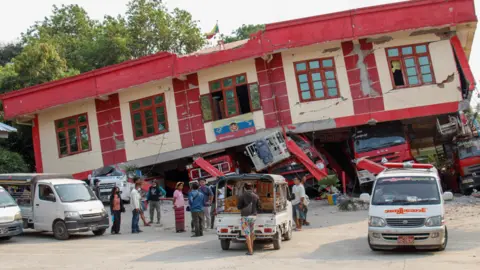
Like other parts of Myanmar affected by the quake, the community is struggling to deal with the sheer number of bodies.
It has been complicated by ongoing fighting between the military junta and resistance groups. The Muslim cemetery in Sagaing is close to an area controlled by the rebel People’s Defence Forces (PDF), and has been closed to the public for several years. The military has continued to bomb some parts of the wider Sagaing region following the quake.
Sagaing city’s Muslim community has had to move the bodies of their dead to Mandalay, crossing the Irrawaddy River using the sole bridge connecting the two cities, according to Soe Nay Oo.
Their bodies are being left at Mandalay’s biggest mosque for burial. Some have not been buried within 24 hours of their death per Islamic tradition.
“For Muslims, it is the saddest thing, that we cannot bury our families by ourselves at the end of their journey,” he said.
The survivors have been trying to help in the rescue, even as they cope with the trauma. “Some from my community told me to pray for them. To be honest, they couldn’t even describe their loss in words when I speak to them.”
It is hard for Soe Nay Oo to be far from his former congregation. Like many other people from Myanmar who have migrated abroad, he feels survivor’s guilt.
“If I were the imam still, at the time of the quake, I would have gone with them – that I can accept peacefully. If not, at least I could be on the ground to do anything that I can.
“Now I can’t go back. It’s painful to think about it.
Soe Nay Oo began to sob. “This sad and frustrated feeling I have right now, I have never felt this way before in my life. I am the kind of man who would hardly cry.
He adds that he has not been able to sleep for days. His worry has been magnified by the fact he has yet to hear from some family members, including his own siblings who were in Mandalay.
Soe Nay Oo has paused his work for a human rights group in Thailand and is currently helping to coordinate rescue efforts in Sagaing – sharing any information he can get from his contacts in the city.
At least 1,000 Muslims in the area have been affected who still need assistance, he estimates.
“I feel relief only whenever somebody on the ground asks for help, and I can help them.”
We still have hope’: Searching for quake survivors in Mandalay
https://bbc.com/news/videos/cx2wljer7wjo
The BBC’s Burmese Service has been speaking to families and rescuers in Myanmar’s city of Mandalay, close to where a deadly 7.7 magnitude earthquake struck on Friday.
The death toll from the quake and a series of aftershocks has climbed past 2,700, with 4,521 injured and hundreds still missing, according to Myanmar’s military chief.
“We still have hope,” one man told the BBC as he waits to find out what happened to his missing sisters, who have been trapped in rubble since last week. He said 11 floors of a building collapsed on them.
Inside Mandalay: BBC finds huge devastation and little help for Myanmar quake survivors
2 days agoShareSave
Yogita Limaye
Mandalay, Myanmar
Warning: This article contains details and images that some readers may find distressing
ADVERTISEMENT
null
Driving into Mandalay, the massive scale of the destruction from last Friday’s earthquake revealed itself bit by bit.
In nearly every street we turned into, especially in the northern and central parts of the city, at least one building had completely collapsed, reduced to a pile of rubble. Some streets had multiple structures which had come down.
Almost every building we saw had cracks running through at least one of its walls, unsafe to step into. At the main city hospital they’re having to treat patients outdoors.
Myanmar’s military government has said it’s not allowing foreign journalists into the country after the quake, so we went in undercover. We had to operate carefully, because the country is riddled with informers and secret police who spy on their own people for the ruling military junta.
What we witnessed was a people who had very little help coming their way in the face of this massive disaster.
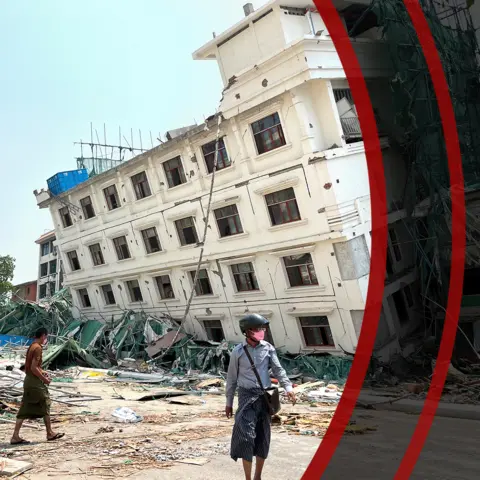
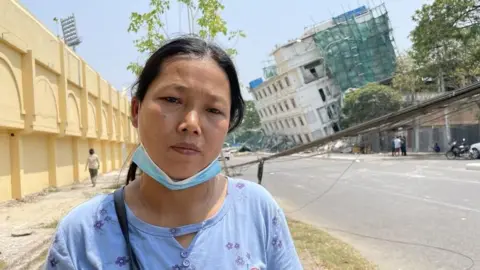
“I have hope that he’s alive, even if it’s a small chance,” said Nan Sin Hein, 41, who’s been waiting on the street opposite a collapsed five-storey building, day and night for five days.
Her 21 year-old-son Sai Han Pha is a construction worker, renovating the interiors of the building, which used to be a hotel and was being turned into an office space.
ADVERTISEMENT
null
“If they can rescue him today, there’s a chance he’ll survive,” she says.
When the 7.7 magnitude earthquake struck, the bottom of the building sank into the ground, its top lurching at an angle over the street, looking like it could tip over at any minute.
Sai Han Pha and four other workers were trapped inside.
When we visited, rescue efforts had not even begun at the building and there was no sign they would start soon. There just isn’t enough help available on the ground – and the reason for that is the political situation in the country.
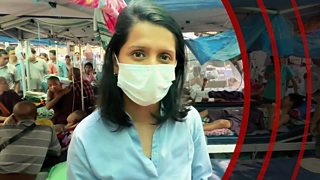
7:02Watch: The BBC’s Yogita Limaye is the first foreign journalist to enter Myanmar since the earthquake struck
null
Even before the earthquake Myanmar was in turmoil – locked in a civil war that has displaced an estimated 3.5 million people. Its military has continued operations against armed insurgent groups despite the disaster.
This means that security forces are too stretched to put their full might behind relief and rescue operations. Except in some key locations, we didn’t see them in large numbers in Mandalay.
The military junta has put out a rare appeal for international aid, but its uneasy relations with many foreign countries, including the UK and the US, has meant that while these countries have pledged aid, help in the form of manpower on the ground is currently only from countries like India, China and Russia, among a few others.
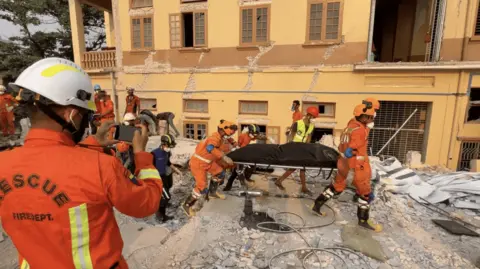
And so far those rescue efforts appear to be focused on structures where masses of people are feared trapped – the high-rise Sky Villa condominium complex which was home to hundreds of people, and U Hla Thein Buddhist academy where scores of monks were taking an examination when the earthquake struck.
Neeraj Singh, who is leading the Indian disaster response team working at the Buddhist academy, said the structure had collapsed like a “pancake” – one layer on top of another.
“It’s the most difficult collapse pattern and the chances of finding survivors are very low. But we are still hopeful and trying our best,” he told the BBC.
ADVERTISEMENT
null
Working under the sweltering sun, in nearly 40C, rescuers use metal drills and cutters to break the concrete slabs into smaller pieces. It’s slow and extremely demanding work. When a crane lifts up the concrete pieces, the stench of decaying bodies, already quite strong, becomes overwhelming.
The rescuers spot four to five bodies, but it still takes a couple of hours to pull the first one out.
Sitting on mats under a makeshift tent in the compound of the academy are families of the students. Their faces are weary and despondent. As soon as they hear a body has been recovered, they crowd around the ambulance it is placed in.
Myanmar earthquake: What we know
ADVERTISEMENT
null
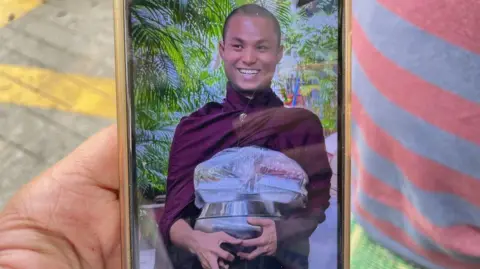
Others gather around a rescuer who shows them a photo of the body on his mobile phone.
Agonising moments pass as the families try to see if the dead man is a loved one.
But the body is so disfigured, the task is impossible. It is sent to a morgue where forensic tests will have to be conducted to confirm the identity.
Among the families is the father of 29-year-old U Thuzana. He has no hope that his son survived. “Knowing my son ended up like this, I’m inconsolable, I’m filled with grief,” U Hla Aung said, his face crumpling into a sob.
ADVERTISEMENT
null
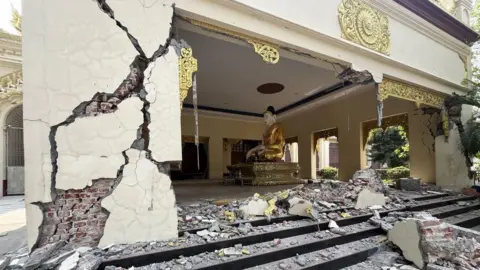
Many of Mandalay’s historical sites have also suffered significant damage, including the Mandalay Palace and the Maha Muni Pagoda, but we could not get in to see the extent of the damage.
Access to everything – collapse sites, victims and their families – was not easy because of the oppressive environment created by the military junta, with people often fearful of speaking to journalists.
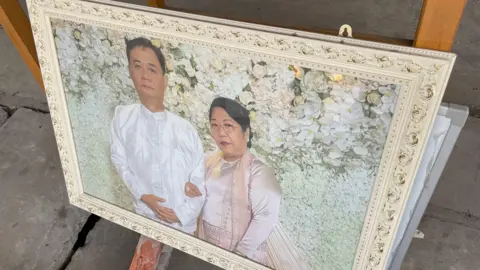
Close to the pagoda, we saw Buddhist funeral rituals being held on the street outside a destroyed house. It was the home of U Hla Aung Khaing and his wife Daw Mamarhtay, both in their sixties.
“I lived with them but was out when the earthquake struck. That’s why I survived. Both my parents are gone in a single moment,” their son told us.
ADVERTISEMENT
null
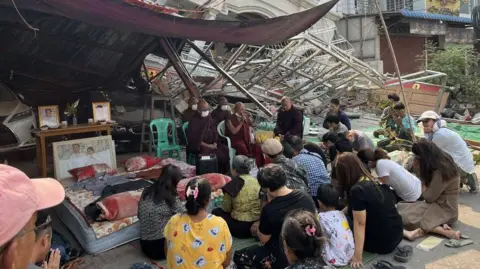
Their bodies were extricated not by trained rescuers, but by locals who used rudimentary equipment. It took two days to pull out the couple, who were found with their arms around each other.
Myanmar’s military government says 2,886 people have died so far, but so many collapse sites have still not even been reached by the authorities, that that count is unlikely to be accurate. We may never find out what the real death toll of the earthquake was.
ADVERTISEMENT
null
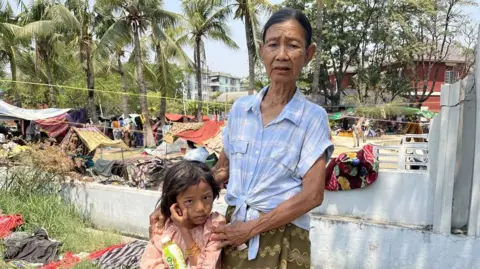
Parks and open spaces in Mandalay have turned into makeshift camps, as have the banks of the moat that runs around the palace. All over the city we saw people laying out mats and mattresses outside their homes as evening approached, preferring to sleep outdoors.
Mandalay is a city living in terror, and with good reason. Nearly every night since Friday there have been big aftershocks. We woke up to an aftershock of magnitude 5 in the middle of the night.
But tens of thousands are sleeping outdoors because they have no home to return to.
“I don’t know what to think anymore. My heart still trembles when I think of that moment when the earthquake struck,” said Daw Khin Saw Myint, 72, who we met while she was waiting in a queue for water, with her little granddaughter by her side. “We ran out, but my house is gone. I’m living under a tree. Come and see.”
She works as a washerwoman and says her son suffers from a disability which doesn’t allow him to work.
“Where will I live now? I am in so much trouble. I’m living next to a rubbish dump. Some people have given me rice and a few clothes. We ran out in these clothes we are wearing.
“We don’t have anyone to rescue us. Please help us,” she said, tears rolling down her cheeks.
Another elderly woman chimes in, eyes tearing up, “No one has distributed food yet today. So we haven’t eaten.”
ADVERTISEMENT
null
Most of the vehicles we saw pulling up to distribute supplies were small vans with limited stocks – donations from individuals or small local organisations. It’s nowhere near enough for the number of people in need, leading to a scramble to grab whatever relief is available.
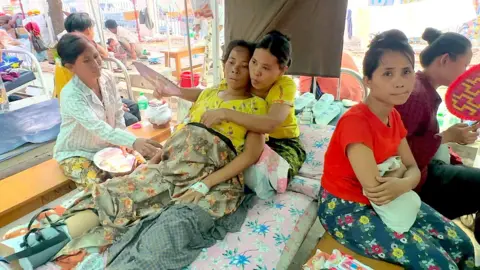
Parts of Mandalay’s main hospital are also damaged, and so in an already difficult situation, rows and rows of beds are laid out in the hospital compound for patients.
Shwe Gy Thun Phyo, 14, has suffered from a brain injury, and has bloodshot eyes. She’s conscious but unresponsive. Her father tries to make her as comfortable as possible.
There were very few doctors and nurses around to cope with the demand for treatment, which means families are stepping in to do what medical staff should.
Zar Zar has a distended belly because of a serious abdominal injury. Her daughter sits behind her, holding her up, and fans her, to give her some relief from the heat.
We couldn’t spend a lot of time at the hospital for fear of being apprehended by the police or military.
ADVERTISEMENT
null
As the window to find survivors of the earthquake narrows, increasingly those being brought into the hospital are the dead.
Nan Sin Hein, who is waiting outside the collapsed building where her son was trapped, was initially stoical, but she now looks like she is preparing to face what seems like the most likely outcome.
“I’m heartbroken. My son loved me and his little sisters. He struggled to support us,” she says.
“I am just hoping to see my son’s face, even if he is dead. I want to see his body. I want them to do everything they can to find his body.”
ADVERTISEMENT
null
 မှတ်ဖွယ်မှတ်ရာ စာပဒေသာ