

Great Rivers of the World 12 videos
Shared to me by World Bank Advisor Senior Engineer Dr။ Ihn Myint. on 31 Nay 2024
Yale Environment 360

In a Dammed and Diked Mekong, a Push to Restore the Flow
Facing increasing land subsidence, saltwater intrusion, and flooding linked with development, Vietnam has committed to changing its approach to managing the Mekong Delta. New initiatives call for retrofitting dikes and dams to restore flood regimes, using nature as a guide.
BY STEFAN LOVGREN • MAY 8, 2024
We depart from Can Tho, the bustling heart of Vietnam’s Mekong River delta, before sunrise, heading south to an aquaculture farm in coastal Cà Mau province. The farm, I’m told, showcases how farmers in the delta are preserving scarce freshwater during the intensely hot dry season.
A drive of several hours takes us through what is known as the country’s “rice bowl” and its aquaculture epicenter. Most striking to a visitor is how nearly every inch of land here is cultivated or built upon. Homes abut shrimp farms, and workers load Melaleuca tree trunks onto trucks. Narrow roads parallel a crisscross of canals constructed for irrigation and transportation.
But all is far from well in what, at first glance, looks like an agricultural paradise. Most of the waterways are dried out, their mud bottoms exposed and cracked. This isn’t unusual in the dry season, but those fissures have grown more visible with each passing year, symbolizing the deepening fractures stressing this region, which is home to 20 million people.
Sand mining in the river and the blockage of essential sediments by upstream dams, mostly in China and Laos, have depleted the delta of its very building blocks, leading to rapid subsidence. With the land sinking, thousands of roads and buildings have buckled and collapsed. And as climate change intensifies, rising sea levels and reduced freshwater flows will force saltwater further onto land, posing a growing risk to freshwater-dependent agriculture like rice farming.
How do you implement nature-based solutions in the Mekong Delta, where 2 percent of the land remains untouched?
The urgency to save the Mekong Delta has rallied international agencies, development banks, the Vietnamese government, local organizations, academics, and farmers. The delta now attracts more funding for environmental initiatives than any other region in Southeast Asia. Crucially, there is widespread consensus on what needs to be done: leveraging so-called nature-based solutions — NBS in conservation parlance — that use natural processes to promote ecosystem health.
NEVER MISS AN ARTICLE
Subscribe to the E360 Newsletter for weekly updates delivered to your inbox. Sign Up.
“We must stop fighting nature,” says Nguyen Huu Thien, a natural resources expert and freelance consultant based in Can Tho.
Nature-based solutions are generally described as measures that protect, restore, or manage natural ecosystems. Examples of typical NBS initiatives are reforestation projects that restore degraded landscapes or the establishment of protected areas to preserve their natural conditions.
But how do you implement nature-based solutions in a region like the Mekong Delta, where as little as 2 percent of the land remains untouched; where enormous dikes have been constructed to reroute natural floodwaters; and where the entire ecological system has been completely altered for agricultural use?

Originating in the Tibetan highlands, the Mekong River traverses six countries before splitting into two rivers below Phnom Penh, the Cambodian capital. Both of these branches reach into Vietnam before fanning out into the delta and the South China Sea. Colonial geographers in the 1800s described the delta as a harsh and malaria-infested place.
In the 1930s, the French began building dikes and polders to lead fresh water into areas where rice could be grown, even in the dry season. While rice can tolerate short periods of water scarcity, it generally requires standing water for a significant portion of its lifecycle, particularly during critical growth stages.
It was not until the 1980s and 1990s, however, that Vietnam, desperate to grow its economy through rice production, developed its vast network of irrigation canals. To support the growth of three rice crops a year, large ring-dike systems were established to both contain fresh water and protect cultivated areas from flooding.
This “rice first” policy helped rescue the war-torn nation from starvation, transforming it into a major rice exporter. But the reengineering of the delta also led to drastic hydrological changes. While the tall dikes in the upper delta protected crops, they increased water levels downstream during peak flood periods, culminating, in 2000, in a catastrophic flood that killed more than 450 people across the delta region.
Problems were also compounding upstream, where hydropower dams built on the main stem of the Mekong River blocked the flow of sediments that would otherwise be flushed downstream to feed farms along the way and help regenerate and rebuild the delta.
The Vietnamese government came to understand that its intensified rice-growing policies were harming the environment and limiting economic opportunities. It began advocating for an agricultural diversification policy aimed at transitioning production from rice monoculture to a more varied farming approach that included aquaculture, fruits, and horticulture. In 2017, legislators passed a law, known as Resolution 120, reflecting the nation’s commitment to sustainably managing and conserving its natural resources.
Many international projects encourage the revival of agricultural practices that take advantage of natural flooding.
“The Vietnamese government recognized the importance of harmonizing with nature,” says Van Pham Dang Tri, the director of the Research Institute for Climate Change at Can Tho University.
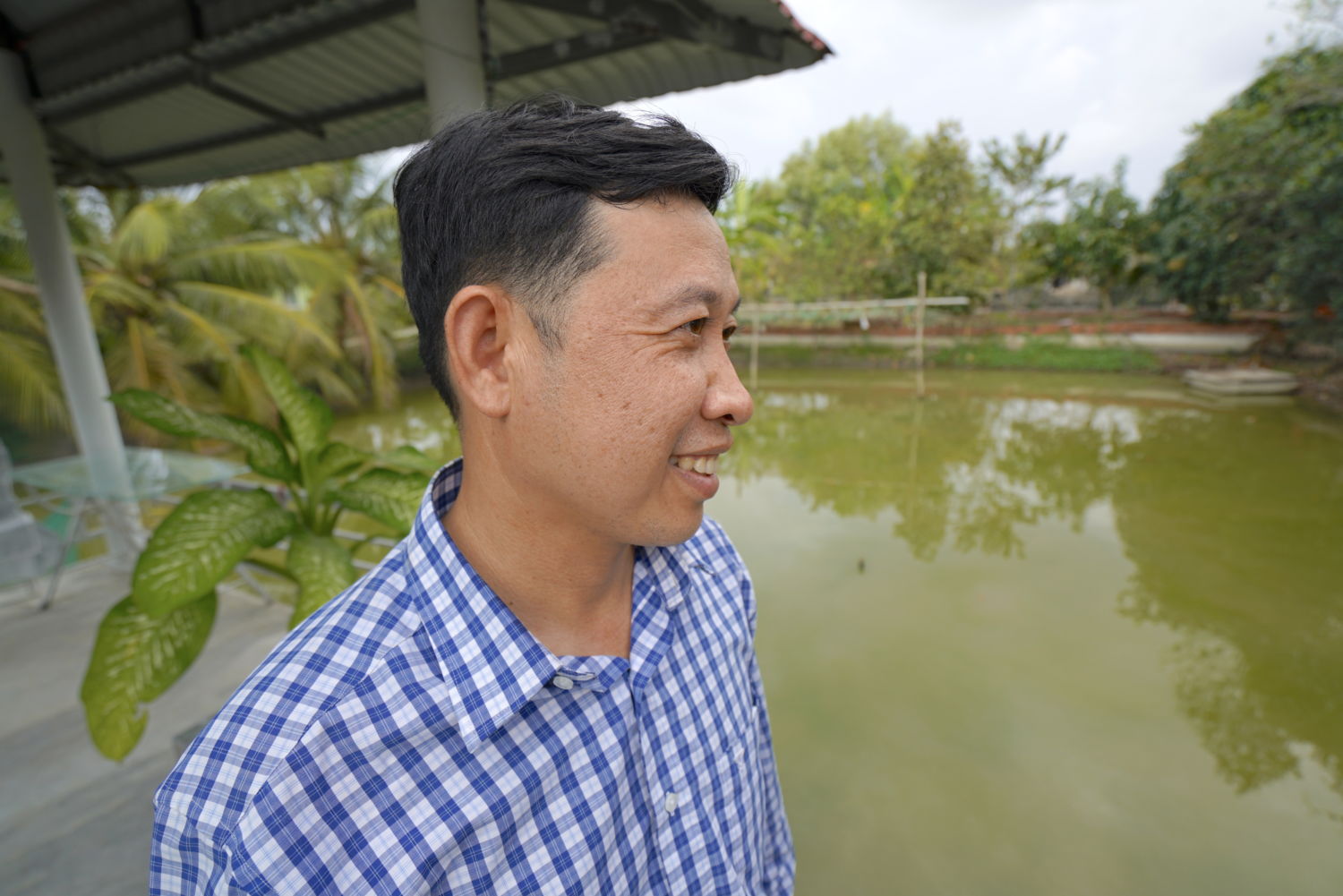
The farm we are visiting, nestled in Phu Tan district near the coast, is owned by Tieu Hoang Pho, who grew up here and works for a government science and technology agency. Like all the local farmers, Pho grows shrimp in ponds connected to saltwater canals. But Pho has also built a freshwater pond that is sealed from its salty surroundings. He collects freshwater during the rainy season and uses it in the dry season to grow freshwater fish. Around the pond, various fruit trees — coconut, jackfruit, banana, mango, and durian — flourish.
Holding several plums while stepping down from a ladder, Pho explains, “This is a multi-value farming model that can be replicated at the household level without expensive infrastructure.” Soon, he says, he will start cultivating water hyacinths, which can be used for everything from animal feed to crafts.
Many international projects encourage the revival of agricultural practices that take advantage of natural flooding, like lotus farming or combining floating rice, which grows in flooded conditions, with fish farming. Such methods have proven far more profitable than monocropping rice. The World Bank, for its part, is backing major initiatives in the upper delta to retrofit dikes to restore natural flood regimes to agriculture.
“We often consider floods as bad, because it’s much easier to measure their damage than their values,” says Marc Goichot, the Asia Pacific freshwater lead for the World Wildlife Fund, which supports flooded agriculture projects that emphasize local community decision-making. “But floods have many benefits, from washing lands of pollutants to bringing nutrients and recharging aquifers.”

ALSO ON YALE E360
On the Mekong, sand mining threatens the river and a way of life. Read more.
Experts point out that simple adjustments to water management infrastructure, such as opening sluice gates within the river and canal network, could also mimic natural flood regimes. Opening these gates to simulate natural flood cycles rather than keeping them closed for saltwater protection would, for example, create aquatic habit and help fish move from river channels into floodplains, where they can feed and breed.
“Now, you hardly find any fish in these intensive rice-growing areas,” says Andrew Wyatt, the deputy head of the Lower Mekong subregion for the International Union for Conservation of Nature, which formulated a global standard for nature-based solutions which states that they must benefit both humans and biodiversity.
Some experts say the Mekong Delta is a case study in how nature-based solutions can be used to mimic natural processes. “For restoring an entire socio-environmental system like the Mekong Delta that is fundamentally threatened by human activities requires us to rethink nature-based solutions beyond the mere local restoration of vegetation,” says Rafael Schmitt, who has long studied dams and Mekong sediment issues and is the lead scientist at Stanford University’s Natural Capital Project.
There are no obvious nature-based solutions to address the loss of sand and sediments, but practices can be improved.
Although the Vietnamese government voices support for environmental policies, some officials still hold onto traditional, rice-focused agricultural approaches for the delta, according to some observers. Projects like the $129 million Cai Lon-Cai Be dual sluice gate, which was intended to block the spread of saltwater and was completed in 2021, have drawn condemnation from critics who claim its backers were motivated by economic interests, rather than commitments to sustainable practices.
Throughout the delta, roads and other infrastructure are crumbling, and land subsidence is occurring up to four times faster than sea level is rising. Studies show that upstream dams trap up to 50 percent of the Mekong basin’s sediment, which would otherwise reach and replenish the delta. The mining of sand, which is used in construction and manufacturing, removes between five and nine times more sand than the amount deposited in the delta annually.
There are no obvious nature-based solutions to address the loss of sand and sediments. But practices can be improved, experts say. For example, dams can be built in places where they don’t cause so much damage, and sand can be extracted from places where it’s less essential for land stability.
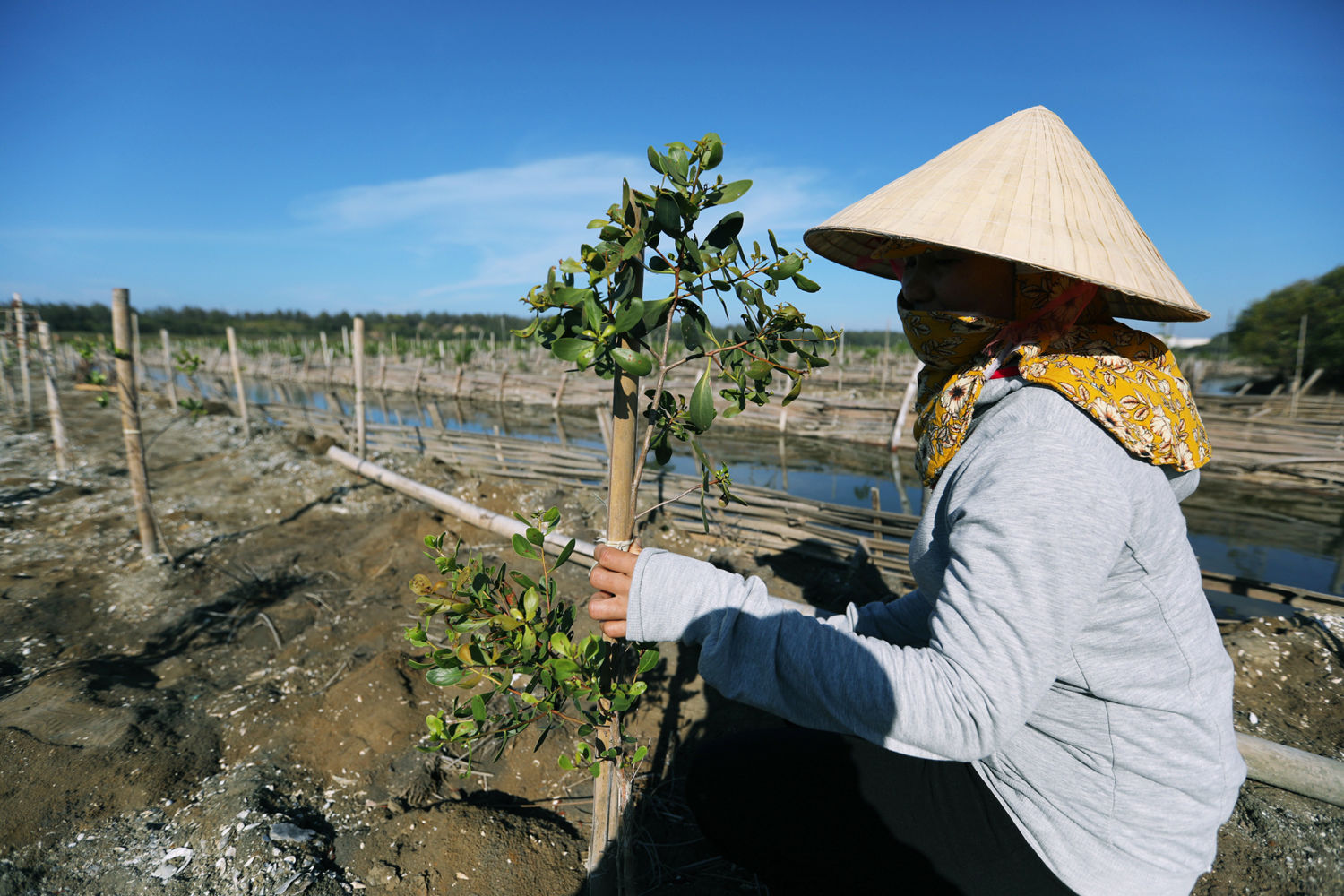
Improving the flow of sand and sediments is also essential for the restoration of mangrove forests, which play a crucial role in mitigating coastal erosion and act as natural barriers against storm surges. Mangrove restoration is thought of as a more traditional nature-based solution than altering processes that restore natural conditions.
But in many places, Vietnam’s mangrove forests were destroyed by applications of Agent Orange during the American war. In other places in the delta, offshore rock barriers — built to protect coastlines from big waves — have altered water and beach dynamics, causing mangrove forests to wash away.

MORE ON YALE E360
In Cambodia, a battered Mekong defies doomsday predictions. Read more.
Several mangrove restoration projects have been initiated in the delta, but the work has been complicated by the reduction in sediment reaching the sea. “Mangroves need to trap enough sediment to build their root systems,” says Schmitt. “If you plant mangrove trees where there is no sediment, you’re wasting your time.”
Back in Can Tho, Thien, the consultant, says the days of engineering and building without regard for nature are over. “Before we were so eager to conquer nature. We didn’t for a minute stop to think how it operates,” he says. “At least now we’re starting to respect natural law. It’s going in the right direction.”

Stefan Lovgren is a researcher at the University of Nevada, Reno, working with the Wonders of the Mekong project. He is also the coauthor of Chasing Giants: In Search of the World’s Largest Freshwater Fish. MOREABOUT STEFAN LOVGREN →
TOPICS
REGIONS
Join the conversation: In a Dammed and Diked Mekong, a Push to Restore the FlowShow comments →
Never miss a feature! Sign up for the E360 Newsletter →
RELATED ARTICLES
- Can a California Oilfield Be Retrofitted to Store Solar Energy?By STEPHEN ROBERT MILLER
- In Seawater, Researchers See an Untapped Bounty of Critical MetalsBy JIM ROBBINS
- Scientists Are Trying to Coax the Ocean to Absorb More CO2By ANDREW S. LEWIS
MORE FROM E360
- ANALYSISPollution Paradox: How Cleaning Up Smog Drives Ocean Warming
- ENERGYCan a California Oilfield Be Retrofitted to Store Solar Energy?
- CLIMATEHow an El Niño-Driven Drought Brought Hunger to Southern Africa
- SOLUTIONSIn Seawater, Researchers See an Untapped Bounty of Critical Metals
- INTERVIEWTracking Illicit Brazilian Beef from the Amazon to Your Burger
- SOLUTIONSIn a Dammed and Diked Mekong, a Push to Restore the Flow
- INTERVIEWHow One South African Community Stopped Shell Oil in Its Tracks
- ANALYSISWill New Leader End Progress in Saving Indonesia’s Forests?
- OCEANSDire Straits: Can a Fishing Ban Save the Elusive European Eel?
- CLIMATEScientists Are Trying to Coax the Ocean to Absorb More CO2
- INTERVIEWMarina Silva on Brazil’s Fight to Turn the Tide on Deforestation
- SOLUTIONSSolomon Islands Tribes Sell Carbon Credits, Not Their Trees
 မှတ်ဖွယ်မှတ်ရာ စာပဒေသာ